Showing posts with label biophysics. Show all posts

Monday, December 3, 2012

2 kinds of mole rats, 2 different cancer-fighting techniques

Did you know there are two (at least) kinds of mole rats? I didn't until recently. Here they are:

Blind mole rat
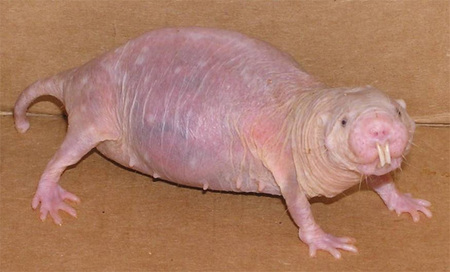
Naked mole rat

Beautiful creatures, aren't they?

Well, they're fascinating anyway. Naked mole rats have been shown to be cancer-resistant. Their cells are programmed to cease division when they sense they are getting too crowded. So any cancerous cells that develop will eventually crowd themselves out of dividing any further, "contact inhibition," as the shop talk goes. Basically, the cancer cells keep quiet about their identity, and do no harm.

Recently, in a paper by a team at the University of Rochester, blind mole rats are shown to also have cancer-fighting properties. However, it seems their potential cancer cells take a different tack. When they sense they have divided more than a normal amount of times, they kill themselves with their form of a cyanide capsule: a protein, IFN-beta. Rather than risk wreaking havoc on their sister cells, they take themselves out of the picture.

It's exciting to think that perhaps these discoveries will help us unleash  hidden knowledge our own cells have. Or to simply help develop a novel drug.

Of course, it's absurd to think the cells have "free will" as I have analogized. Nonetheless, I couldn't help thinking about Battlestar Galactica when thinking about cells discovering they were something else. By the way, if you haven't seen it, don't wait around, just do it.

Friday, November 30, 2012

Protein Folding

I'm currently in the process of going through a monstrous stack of periodicals I've accumulated, including the magazine Physics Today, which comes with my APS membership.

This article by Ashley Smart is simply a research summary on experiments on proteins.

But Smart evoked a lot of thoughts about proteins. We need them to be folded correctly to work, but how are they folded? How is this the minimum energy state.

Smart's description of various denatured (unfolded) proteins reminded me a lot of the language used in the glass/jamming community. A fried egg consists of proteins denatured by heat. A similar transition happens for
"glassy" systems: raise the temperature and the material will flow.

Mechanical stress can cause also cause the protein in egg white to denature, resulting in a foamy, stiff, meringue. In jammed systems, like mayonnaise, mechanical stress (i.e. using a butter knife) causes the material to unjam (i.e. deform and spread on the sandwich).

The third variable discussed in the jamming community is volume fraction, which I won't delve into here. The third variable for the egg example is acidity, mixing egg whites with lime juice will also cause the proteins to denature. Completely different, can't win 'em all.

What also drew me into this simple piece was the description of the experiments. (Smart does a commendable job of trying to explain the math in words.) There are two processes that contribute to the overall signal the researchers measure, only one of which relates to protein folding. But if you change the temperature, each process responds on a vastly different timescale.Taking measurements at the right frequency and using a trick of derivatives, they can isolate the process of interest. An experiment like this would be a great lab in a biophysics class.

Thursday, September 20, 2012

Naked Mole Rats FTW

I have seriously been told I resemble a naked mole rat when I'm roused from sweet, sweet slumber. My eyes refuse to open, and I burrow under the sheets. I'm pretty pale and mostly hairless, too.

While I hope I don't resemble a naked mole rat in all ways (a bit on the uncomely side) I think there's reason to hope my cells act like their's.

Naked mole rats never get cancer.

Wednesday, September 19, 2012

Real nanobots !!!! (???)


With fancy chemicals being developed for new medicines, a question remains: how can we deliver the most bang for the buck? It would be ideal to have a microscale delivery truck, capable of delivering the drug to the precise location needed. This would also eliminate many side effects experienced through a general delivery of the drug.

 Catalytic nanoswimmers are being researched as potential cargo vehicles. They are tiny spheres, with one half coated with a reactive material. This side reacts with chemicals in the environment, and the energy of reaction is transmitted into motion forward. Attach a blob of drug to them, and they can move medicine. But questions remain about how to get them to go a specific direction, without having to babysit them. Can we make these trucks driverless?

Tuesday, January 10, 2012

Adhesion, Geckos, and Technology

One of our earlier experiences with science comes in kindergarten. The teacher brings out the Elmer's glue and we put macaroni on construction paper. The white viscous stuff acts to permanently bond the paper and pasta. As children we're ignorant of the science beneath this and view glue as magic stuff. But if we could zoom in to resolve the detail, we’d see the long squiggly polymer molecules in the glue are grabbing onto the fibers in the paper as well as the starch fibers in the macaroni. The glue acts as an adhesive.

Thursday, February 10, 2011

How DO bacteria swim with no arms?

You had to skip breakfast today. To compound your misery, a delicious smell
permeates the office. Who ordered pizza? Your stomach growls. You wander around
the hallways and follow your nose to the source of the smell. A few boxes sit unat-
tended in the conference room. A sign in your boss’s handwriting threatens, “DO
NOT EAT.” You sneak a slice anyway, undetected. How do bacteria find food when
they are hungry?

Monday, January 3, 2011

How do you make a nanobot?


Here is an essay I wrote while reflecting on and researching a lecture I heard by Yale Goldman, Professor of Physiology at the Pennsylvania Muscle Institute, and associate director of the NBIC at Penn.


How do you make a nanobot?

Imagine you are playing with a set of Legos. This set is one of the newer
ones. It has all kinds of blocks, gears, wheels, pulleys, batteries, etc. Put different
combinations of them together and you can build a house or maybe if you’re feeling
clever, a machine. Suppose you make a small battery-powered car. Imagine shrinking
this car. As it shrinks, the number of atoms in each Lego block must become fewer.
Eventually, you may reach the limit where each block is one atom. What if we could
make machines like this?